

Why Your Heating System Requires Hydraulic Separation For Multiple Pumps
Updated: Jun 25
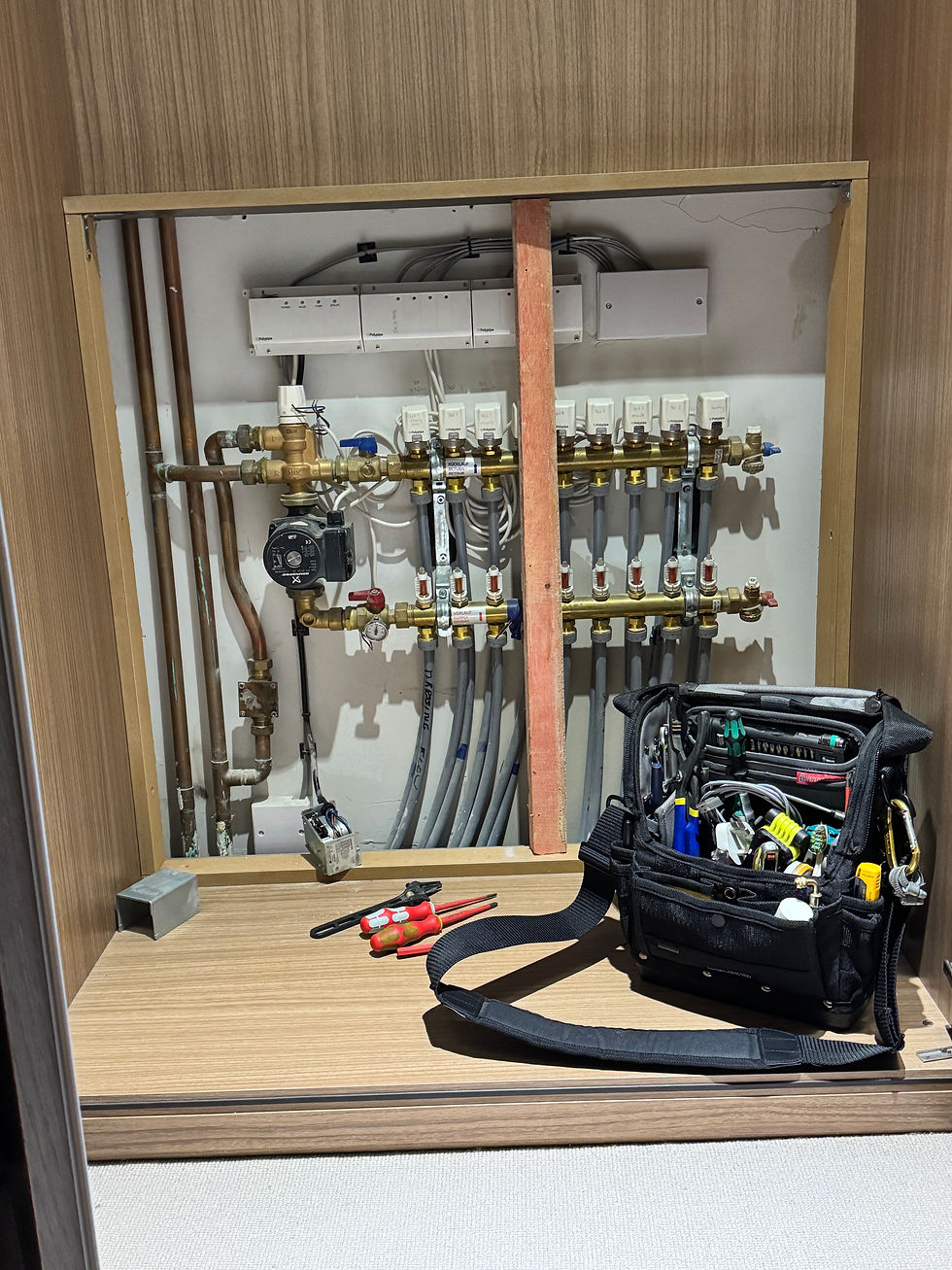
Our Gas Safe heating engineers successfully upgraded an existing heating system in Woodford Green that was putting pressure on the boiler and its pump. This system comprised 3 circuits: 2 underfloor heating circuits and 1 unvented hot water cylinder circuit, each with a pump. The boiler was a Baxi Potterton Promax system boiler with an Grundfos 15-60 internal pump.

In this system, up to three pumps were operating through the boiler depending on circuit demand - ranging from all circuits open to partial operation with two or a single pump engaged. This fluctuating flow profile created inconsistent hydraulic conditions across the boiler, which negatively affected performance. As a result, the boiler struggled to maintain stable operation, leading to periods of overheating or underheating while continuously attempting to regulate set heating pressure and respond to variations in pump-driven flow dynamics. This consistent over heating created scaling of the internal components and eventually failure of the pump valves and expansion vessel.
The upgrade was simple but effective. With the adjustment of the pipework under the boiler and the addition of a common header we were able to bring this system into a more controllable state. The boiler instantly sounded quieter in operation. Other parts replaced on this installation were, 2 port control valve, filling loop and an additional auto air vent fitted to the pipework for effective venting of tapped air as well as cleaning and descaling of the boiler pump and air vent.

As the boiler is set up as a fixed temperature system, this was the most cost-effective way of resolving the issue without changing too much of the system's controls. When this boiler is ready to be changed, a complete re-pipe will take place with proper controls to allow for increased comfort and performance - utilizing weather compensation and priority domestic hot water.
What Does "Pumps Fighting Each Other" Actually Mean?
Every pump in a heating system is designed to move water at a certain flow rate and pressure. When you have one pump on one simple circuit, that's straightforward; the pump does its job and nothing interferes with it.
The problem starts when multiple pumps are connected to the same pipework without any separation between them. Each pump tries to set its own flow rate and pressure across the shared pipework, but they're not designed to cooperate. One pump's output works against another pump's suction. The result is turbulent, unpredictable flow that varies depending on which zones happen to be calling for heat at any given moment.
The Symptoms Homeowners Actually Notice
You don't need to understand pump curves to know something is wrong. These are the signs we're called out for most often in Woodford Green properties with multi-zone systems:
• Some radiators or underfloor zones heat properly while others barely warm up, and it changes depending on what else is running
• The boiler cycles on and off more than it should, even when the house hasn't reached temperature
• Banging, gurgling, or whistling noises from pipework, particularly near the boiler or manifold
• Hot water performance drops when the heating is also calling for heat
• Higher gas bills than the size of the property would suggest
• A previous engineer has "balanced" the system more than once, and it never stays balanced for long
If you're nodding along to two or more of these, hydraulic separation is very likely the underlying fix, not another round of rebalancing.
What Is Hydraulic Separation?
Hydraulic separation means physically and hydraulically isolating the boiler's pumping circuit from the rest of the system's pumping circuits, so that pressure changes on one side don't affect the other. Instead of every pump fighting for control of one shared loop of pipework, each circuit gets its own independent loop, separated by a device that absorbs the difference between them.
The most common way to achieve this in a domestic or larger residential setting is a low loss header (LLH).
What Is a Low Loss Header, and How Does It Solve This?
A low loss header is a manifold, usually a vertical chamber, that sits between the boiler circuit and the distribution circuits (your zones). The boiler's primary pump pushes heated water into the header. Each zone pump then draws from the header independently to feed its own circuit.
Because the header has a much larger cross-sectional area than the pipework feeding into it, the velocity of the water drops sharply inside it. This is what creates the separation: each pump effectively only "sees" its own circuit and the header, not the other three pumps on the system. The boiler side and the zone side become hydraulically independent.
In practical terms, this means:
• The boiler's primary circuit runs at a constant, correct flow rate regardless of what the zones are doing
• Each zone pump can run at the flow rate and pressure that specific zone needs, without interference
• Zones can switch on and off independently without disturbing the rest of the system
• The boiler stops short-cycling because it's no longer responding to pressure fluctuations caused by other pumps
• Flow rates can be set independently for each circuit, useful when, for example, underfloor heating needs a much higher flow rate than a radiator circuit.
Other Methods of Hydraulic Separation
A low loss header isn't the only option, and on some systems a different approach is more appropriate:
Plate heat exchanger separation - fully isolates the boiler's water from the system water, useful where water quality, pressure, or system volume differs significantly between circuits, see our installation here.
Buffer vessel (volumizer) – adds thermal mass to the system as well as hydraulic separation, which helps modulating boilers run more efficiently and reduces cycling further, particularly useful where boiler output is significantly larger than the heat demand of individual zones
Close coupled tees - reduces pressure loss from the circuits connected, different flow rates can be achieved in each circuit removing the conflict from multiple pumps on a system. See our video here.
Headers - a larger sized pipe that allows water to flow independently in either direction regardless of the heat demand. Usually fitted near the boiler and before the secondary circuit, does not include vents or filtration. This post.
Which option is right depends on the boiler, the number and type of zones, and how the system was originally designed. This is very much a case-by-case assessment rather than a one-size-fits-all fix.
Why This Is So Common in Woodford Green Properties
Woodford Green has a lot of larger period and extended properties: homes that have had loft conversions, rear extensions, conservatories, or basement developments added over the years. Each addition is a natural point where a new heating zone, and a new pump, gets bolted onto the existing system, often without anyone re-assessing whether the original pipework and boiler setup can actually support multiple independent circuits.
It's rarely the result of bad work at the time. A single pump added for a new extension is a perfectly reasonable solution in isolation. The problem only shows up once you've got three or four of these additions stacked on top of each other, all sharing pipework that was never designed to separate them.
Why Get a Manufacturer-Trained Engineer to Assess This
Hydraulic separation isn't a bolt-on part you can add anywhere in the system. Getting it right means correctly sizing the header or buffer vessel for your actual flow rates, positioning it correctly relative to the boiler and zones, and making sure boiler controls are reconfigured to work with the new arrangement rather than against it.
As Viessmann and Vaillant manufacturer-trained installers, we assess the whole system, not just the symptom you're calling about. That means looking at boiler output, zone demand, pipe sizing, and controls together, so the fix addresses the actual cause of the pump conflict rather than masking it for a few months until it reappears.
Heating Behaving Strangely in Your Woodford Green Home?
If your system has multiple pumps, multiple zones, and heating that never quite behaves the same way twice, it's worth having it properly assessed before paying for another round of "rebalancing" that won't hold. Get in touch with LHS Plumbing Services on 020 8111 1230 and we'll take a proper look at what your system is actually doing.
Frequently Asked Questions
What is hydraulic separation in a heating system?
Hydraulic separation is a method of isolating the boiler's pumping circuit from other pumping circuits in a heating system, so that each pump can operate independently without interference from the others. It's typically achieved using a low loss header, plate heat exchanger, or buffer vessel.
How do I know if my heating system needs hydraulic separation?
Common signs include uneven heating between zones, frequent boiler short-cycling, unusual noises from pipework, and a system that needs repeated rebalancing. Systems with multiple pumps serving different zones (underfloor heating, radiators, towel rails) are most at risk of pump conflict.
Is hydraulic separation only relevant to large or commercial systems?
No. While it's standard practice in commercial systems, many larger residential properties, particularly those extended over time with multiple heating zones, benefit just as much from hydraulic separation as commercial buildings do.
How much does adding a low loss header cost?
This depends on the existing system layout, boiler type, and number of zones involved. A proper assessment is needed before any accurate cost can be given, since the work involves more than fitting a single component.
Will I have space for hydralic seperation
This all depends on the space that is avalible, We custome make units to fit most spaces and have be successful in creating hydralic seperation in all heating systems that our engineers have worked on.


Comments