

Why Water Quality Is the Most Important Subject in a Heating System
When we talk about heating-system efficiency, we often focus on the boiler, controls, radiators and pipework. But one subject is arguably more important than all of them: the water circulating inside the system.
A heating system can have an excellent boiler and sophisticated controls, but if the system water is contaminated, poorly conditioned or repeatedly diluted with fresh mains water, corrosion, magnetite, sludge and component failure can follow. Good heating-system water quality is therefore not achieved by one product alone; it is the result of correct installation, cleaning and ongoing water management.
My Heating System Has No Magnetic Filter or Air Separator
Interestingly, my own system does not currently have a magnetic filter or dedicated air separator fitted.
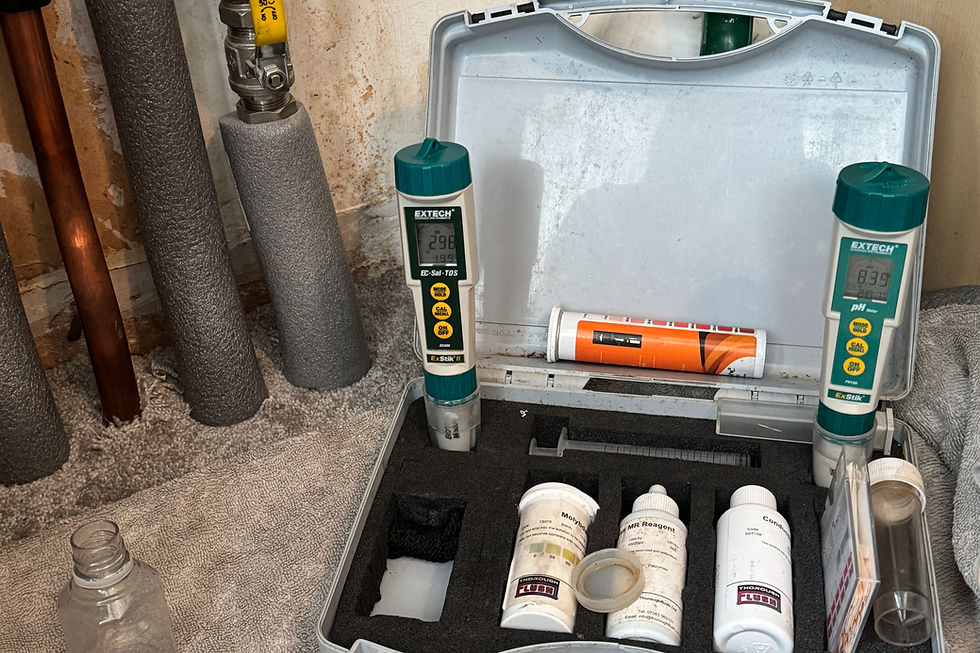
Instead, I take a different approach: annual water-quality testing and active management of the system water.
There are no leaks, the system is not continually being topped up, and the heating water is now maintained in accordance with the principles of VDI 2035, which focuses on controlling water quality to reduce corrosion and deposits.
The system has also been flushed several times historically to remove magnetite and accumulated debris.
That doesn't mean I believe filters and air separators are unnecessary. They can provide valuable protection, particularly on new installations, older contaminated systems and systems where controlling dirt and dissolved gases is important. Filtration is an important part of maintaining heating-water quality.

Low-Temperature Heating Changes the Equation
My system operates using load compensation, keeping the flow temperature below approximately 55°C rather than simply running the boiler at a high fixed temperature.
The radiators have been designed around ΔT30, making them suitable for lower-temperature operation.
The system has also been correctly balanced, ensuring that water flow is distributed appropriately around the property.
The thermostat is set to maintain approximately 18°C when the property is unoccupied and 20°C when occupied. This provides a stable heating demand rather than large temperature swings.
The Boiler Is Already Eight Years Old
The Vaillant combi boiler is now eight years old, which makes water quality even more relevant.
The objective isn't simply to keep the boiler working today. It is to minimise corrosion, deposition and contamination so that the boiler, pump, valves, radiators and heat exchangers can continue operating efficiently.
Water Quality Is Part of the Heating-System Design
I believe water quality should sit alongside the other fundamental considerations when designing or upgrading a heating system:
Boiler selection
Heat-loss calculations
Radiator sizing
ΔT and flow rate calculations
Hydraulic balancing
Load compensation or weather compensation
Magnetic filtration
Air separation
System cleaning
Ongoing water-quality testing
VDI 2035 demonstrates an important shift in thinking: protecting a heating system starts with controlling the water itself, rather than relying solely on chemicals or filtration equipment.
A magnetic filter is useful. An air separator can be useful. A system flush can be essential.
But ultimately, the best heating system is one where the water inside it is understood, tested and maintained.
That is why water quality should be treated as a fundamental part of heating-system design and maintenance - not an afterthought.
Why LHS Plumbing Services Takes a Different Approach
LHS Plumbing Services has spent years testing, researching and refining its approach to heating-system water quality.
Our experience has shown that simply adding inhibitor is not always the complete solution. We have found systems where inhibitor-treated water is showing elevated iron levels, while clean mains water samples show no comparable iron contamination and low TDS readings.
This raises an important question:
Are we actually treating the cause, or simply treating the symptoms?
Inhibitor can provide valuable protection, but it is not necessarily a permanent solution. Its effectiveness can reduce over time, and where the original inhibitor type or concentration is unknown, establishing a known water-quality baseline can be a more controlled approach.
In some circumstances, that means flushing the system, establishing the water quality and then deciding what treatment is actually required.
Why VDI 2035
VDI 2035 takes a different approach.
The objective is to control the heating-water conditions to minimise:
Corrosion
Scale formation
Deposits
Contamination
Unnecessary chemical dependency
Clean water does not automatically mean perfect heating water either. Water chemistry, hardness and operating temperature can all influence scale formation, particularly around heat exchangers.
The objective is therefore not simply:
“Put inhibitor in the system.”
It is:
“Understand the water, control the water and maintain the water.”
That is a much more proactive approach to system protection.
Why Isn't VDI 2035 Used More Widely?
There is a practical reason.
Implementing a water-quality strategy properly takes time, equipment, knowledge and ongoing testing.
Engineers need to assess the system water, understand the results, determine the appropriate treatment strategy and, where necessary, continue monitoring it.
There is also a financial consideration.
Testing equipment, training and additional labour all increase the initial cost compared with simply adding a bottle of inhibitor.
What Does Poor Water Quality Cost Over the Lifetime of a Heating System?
Corrosion, sludge and scale can contribute to:
Restricted circulation
Sticking or failed valves
Pump problems
Blocked components
Fouled heat exchangers
Reduced heat transfer
Increased maintenance
Premature component replacement
The cost of proper water management therefore needs to be compared with the potential cost of repeated remedial work and component failure.
VDI 2035: A Proactive Strategy
For LHS Plumbing Services, this is why we see VDI 2035 as a proactive rather than reactive approach.
Instead of waiting for contaminated water to cause problems, the objective is to establish and maintain stable water conditions that help protect the heating system throughout its working life.
The goal isn't simply:
A cleaner system today.
It is:
A better-performing, more predictable and potentially longer-lasting heating system tomorrow.
Water quality should therefore be treated as a fundamental part of heating-system design, commissioning and maintenance — not an afterthought.


Comments