

Water Quality in Central Heating Systems
Why pH Matters and Why We Test Every Boiler
When it comes to boiler servicing and heating system repairs, water quality is often overlooked. Yet the water circulating around a central heating system has a direct impact on the condition, efficiency and working life of boilers, heat exchangers, pumps, radiators and valves.
At LHS Plumbing Services, we believe a boiler service should be more than simply checking the appliance and issuing a certificate. We also look at the condition of the heating system water because poor water quality can be an underlying cause of repeated boiler faults, corrosion, sludge and premature component failure.
What is the ideal pH for a central heating system?
pH measures how acidic or alkaline water is.
A pH of:
7 is neutral
Below 7 is acidic
Above 7 is alkaline
For a typical closed-loop domestic central heating system containing steel, copper, brass and aluminium components, maintaining the correct water chemistry is important.
There isn't one universal pH figure that applies to every heating system because the optimum range depends on the materials and water-treatment products being used. In practice, treated heating-system water is generally maintained on the mildly alkaline side rather than acidic.
For many traditional systems, a pH around 8–9 is commonly targeted. However, aluminium heat exchangers require particular care, and the boiler manufacturer's specified water-quality limits should always take priority.
This is one reason we don't simply say that "higher pH is better". Excessively alkaline water can also cause problems, particularly with aluminium components.
Why does pH matter?
If the water becomes too acidic, it can accelerate corrosion of metal components.
Corrosion can lead to:
Rust and magnetite formation
Sludge accumulation
Blocked heat exchangers
Sticking valves
Pump problems
Radiator corrosion
Reduced heat transfer
Leaking components
Increased boiler noise
Premature heat-exchanger failure
On the other hand, poorly controlled water chemistry can also contribute to scale formation and other deposits.
The objective isn't simply to achieve a particular pH number. The objective is to maintain water chemistry that is appropriate for the entire heating system.
What causes poor heating-system water quality?
There are several common causes.
Oxygen entering the system
Oxygen is one of the major drivers of corrosion.
A correctly installed sealed heating system should have very little oxygen circulating once it has been filled, vented and stabilised. However, oxygen can enter through repeated system top-ups, leaks, poor air elimination or unsuitable system design.
Every time a customer repeatedly repressurises their boiler, fresh oxygenated water is potentially being introduced.
This is why a boiler that regularly loses pressure should not simply be topped up indefinitely. The reason for the pressure loss needs to be investigated.
Corrosion
Different metals within a heating system can interact electrochemically.
Steel components can produce magnetite and other corrosion products. These particles can circulate through the system and eventually accumulate in vulnerable areas such as:
Boiler heat exchangers
Pumps
Motorised valves
Radiator valves
Low-flow areas
Plate heat exchangers
This is one of the reasons system cleanliness and filtration are so important.
Scale
Hard water contains minerals such as calcium and magnesium.
When water is repeatedly heated, dissolved minerals can form deposits. This is particularly relevant to domestic hot-water circuits and plate heat exchangers.
Scale can reduce heat transfer and restrict waterways, potentially increasing operating temperatures and reducing efficiency.
How do we protect heating-system water quality in the UK?
Good heating-system water quality isn't achieved by one product alone. It is normally a combination of correct installation, cleaning, filtration, chemical treatment and ongoing maintenance.
1. System cleaning and flushing
When installing a new boiler onto an existing heating system, the condition of the existing water should be considered.
Depending on the condition of the system, cleaning may involve oneor some of the following:
Chemical cleaning before the old boiler is removed
Hot Flushing
Power flushing where contamination is high
Removing existing sludge from internal pipework
Cleaning radiators internally
Removing contaminated system water
The objective is to remove existing contaminants before introducing a new boiler into the system.
2. Inhibitor
A suitable heating-system inhibitor can help control corrosion and maintain appropriate water chemistry.
However, inhibitor isn't a substitute for cleaning a dirty system.
Adding inhibitor to heavily contaminated water doesn't magically remove the existing sludge and corrosion products.
Clean first, then protect.
3. Magnetic filtration
Magnetic filters are widely used in UK heating systems to capture ferrous corrosion products such as magnetite.
A correctly selected and installed filter can provide an additional layer of protection for the boiler and other system components.
However, filters need to be installed correctly and maintained. A filter that is never cleaned isn't providing the same level of protection as a properly maintained one.
4. Air and dirt separation
Modern heating installations can also benefit from effective air and dirt separation.
Removing microbubbles and suspended debris can help reduce corrosion-related problems and protect components such as pumps and heat exchangers.
5. Correct system design
Water quality starts with the design of the system.
Correct pipe sizing, hydraulic design, circulation, expansion control, air elimination and system cleanliness all contribute to long-term performance.
Water treatment is therefore not simply a chemical issue—it is part of the overall heating-system design.
Why LHS tests the water during boiler servicing and repairs
At LHS Plumbing Services, we take a different approach to boiler servicing.
A boiler doesn't operate in isolation. It is connected to a complete heating system.
If we find a boiler that is repeatedly suffering from a blocked heat exchanger, poor circulation, noisy operation or component failure, simply replacing the failed component may not address the underlying problem.
The system water may be part of the problem.
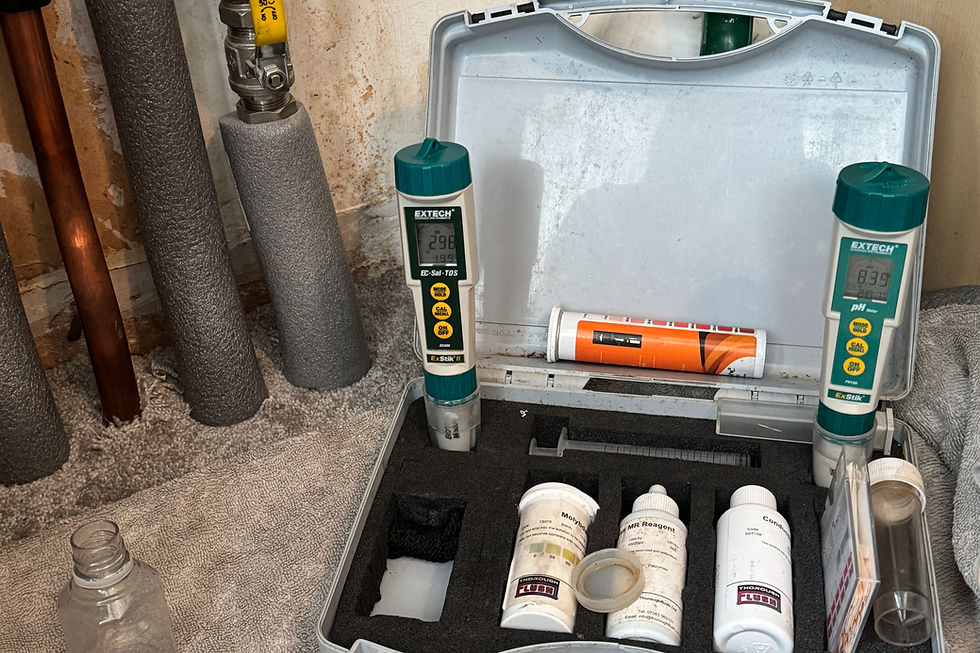
This is why, where applicable, we carry out heating-system water-quality checks during servicing and repair work.
We can look at parameters such as:
pH
TDS (Total Dissolved Solids)
Appearance and cleanliness
Evidence of corrosion products
Inhibitor condition/concentration where appropriate
Signs of contamination
System pressure and behaviour
These checks give us additional information about what is happening inside the heating system.
Why TDS is useful
TDS stands for Total Dissolved Solids.
It gives an indication of the amount of dissolved material present in the water. A high reading doesn't automatically mean that a heating system has a fault. TDS can be affected by the source water, system condition, treatment chemicals and whether the system has recently been filled or topped up.
However, when combined with other measurements, TDS can provide useful diagnostic information.
This is why we don't rely on a single test.
Water-quality testing is about looking at the overall picture.
What happens when we find poor water quality?
If testing identifies a potential water-quality issue, we don't simply recommend replacing the boiler.
First, we establish what is actually happening.
Depending on the system, this could lead to recommendations such as:
Investigating repeated pressure loss.
Checking for leaks or unwanted fresh-water ingress.
Cleaning or flushing the heating system.
Checking or installing appropriate filtration.
Testing and restoring inhibitor protection.
Correcting system design or circulation problems.
Carrying out further water-quality testing.
The appropriate solution depends on the individual system.
Why this matters for modern boilers
Modern boilers can be highly efficient, but their heat exchangers and waterways can also be relatively compact. That means contamination, deposits and poor circulation can have a significant effect.
A boiler may be perfectly healthy when it leaves the manufacturer's factory. If it is connected to a heavily contaminated heating system, however, the boiler is exposed to the condition of that system every time it operates.
This is particularly important when replacing an older boiler. Installing a new boiler onto an old, dirty heating system without addressing the condition of the system water can be a false economy.
Water quality is part of boiler maintenance
A boiler service should not be viewed purely as an appliance inspection.
The boiler, pipework, radiators, pumps, valves and water treatment all work together as one heating system.
At LHS, our approach is to look beyond the immediate fault and consider why the problem occurred in the first place.
Testing the system water gives us another diagnostic tool and helps us identify potential problems before they develop into expensive component failures.
LHS Plumbing Services — Heating System Water Quality
Whether we're carrying out a routine boiler service, repairing a heating system or installing a new boiler, we believe water quality should be part of the conversation.
Correct pH, appropriate water treatment, effective filtration, good system design and regular maintenance can all contribute to a cleaner, more reliable and longer-lasting heating system.
Don't just service the boiler. Look after the system it's connected to.
If you're experiencing repeated boiler faults, noisy heating, dirty system water, pressure problems or recurring heat-exchanger issues, a water-quality assessment can help identify what is really happening inside the system.
LHS Plumbing Services — Plumbing, Heating & Gas Specialists across London and Essex.



Comments